Sunday, November 19, 2017

Synthesis Post

By: Laryia, Liz, Joe, and Lucas

Photo Credit: GoodTherapy.org

The fields of education and psychology are two very important subjects in which the world needs. Many people over look both of these careers and do not think of the real significance they have on others. The fields of education and psychology have various aspects to them that a lot of people are unaware of, in which our blog explains.

       People believe that being a teacher is just about waking up at 6 AM, reading off PowerPoint slides for a couple hours, and grading until 6 PM, but that’s the exact opposite. Teachers do put in work hours evenly compared to the stereotype, but they go beyond what they can do. For example, one of my history teachers in high school would stay a whole hour after school in the library if anybody needed help and would arrive 30 minutes early on test/quiz days if anyone had additional questions. For me wanting to become a history teacher, my job goes past teaching about the rise of fascism and military conflicts. Sure, it would help for all of the students to ace my class, but I could have a student who goes to school to get away from troublesome environments. You need to get to know your students beyond just being someone you teach. Improving relations with them can make a huge difference. Don’t be afraid to pull someone aside after class to just talk because you could make that person’s day a lot better. Teachers don’t strictly just give people a path to diplomas; they also help them become better citizens. When you look back on your teachers in college or high school, do you want them to be remembered as someone who was strict and not the most social? Or as someone who took the extra step to make everyone succeed?

       What teacher is it you want to be for your student? Maybe people think it’s simple only because the definition of a teacher is someone who teaches especially in a school, and nothing else. However as we previously said there is much more to it. You shouldn’t only want to teach the subjects that are required. You should strive to be a good teacher, as you should want to be good at all you do. There is many things you must know, acknowledge, and consider to be a good teacher. Stop and think what kind of teacher it is that you would like for your kids to have? Remember this person will be the other adult in your kids life. Teachers are extremely influential in kid’s life, they will learn good and bad from their teacher. Your kids will listen and do what his/her teacher says.Your students, your kids! Be the teacher you would want your kid to have! Not only will you influence these kids, but you will also affect and impact their life. Hopefully you make the correct and responsible choice. Not only do teachers carry this much power in kid’s life but so do psychologist.

Just as they do for teacher, people over look a psychologist. People believe majoring in psychology is simply listening to someones problems all day long. Psychology is much more than scribbling on a notepad while nodding your head, barely listening to someone speak on their issues. Psychology is helping, making an impact, and discovering new research. The study of psychology is exploring the mind, brain and behavior. It is learning why people act the way they do, or how the brain functions in the way it does. Psychology has various subfields such as learning social behaviors, cognitive thinking, diagnosing diseases, and where these areas stem from. Psychology is making a difference that could potentially save someone's life. There are various careers you can achieve with a degree in psychology than just being a therapist. In 2013, there were 2.5 million people in the labor force with a degree in psychology.  Read our post about the common misconceptions of psychology here to find out more of what this field is about.

Furthermore in order to be influential to your students or anyone in this world, you must know how they think, how that coincides with your way of thinking, and how to meet a common ground between you and them. This is where psychology is more important than it seems to be. A good teacher is one that can teach the class and receive good grade results from them, but a great teacher, the ones who are remembered can teach a class fluently and has a severe impact on their future lives. Many people think psychology is just the study of the brain and its functions, but they neglect the impact that knowledge could be used for. We have several posts on the blog that go more in-depth about the topics but in short-terms - psychology is about learning the tendencies and functions of the brain, and so we can learn how to enhance it, our lives, and other lives in the process of it.

The fields of psychology and education are both important fields. They both involve helping others and involve thinking of everyone else before yourself. It is hearing people out and doing what you can to listen, teach, or help somebody else. This blog will help you explore all the aspects of these fields, their relations, and what they truly entail.

Benefits for Teaching

When you're a teacher, you often get asked "Why not do something that pays you a little more?" Even though they can be right to an extent, teachers get special privileges that others might not. For example, they only have to work 8-10 months out of the year and get paid annually and get paid sick days and leaves.

But what happens when you retire?

Once a public school in Michigan hires you, you’re entered into their retirement system. The system as of today helps 190,000 retirees and has distributed $3.5 billion in pension since 2010. This is a contributory pension system, which means that teachers receive lifetime monthly pensions upon retirement. You can retire at any age as long as you have 30 years of experience. These benefits rely on your years of service and average salary. For example, if you worked for 25 years and your average salary was $55,000, you would receive lifetime monthly benefits of around $1,720.

Credit to:  Financial Alliance

The past couple years, we had to go through ObamaCare, and now the Affordable Care Act. Premiums for insurance have fluctuated both ways and people can still be worried about what is to come. If you're a teacher, have no fear, for you get insurance benefits too. Some schools offer plans which would cover 100% of your medical expensive, and some are not as friendly with the percentage. Teachers in Michigan typically enter into dental and vision insurance plans. My sister, for example, only has a $5/month dental deductible. These plans very on what they can cover. Not all of them are the same.

So the next time someone asks you "Why teach?" or use the phrase "You won't get paid much", remind them of the benefits you get!

- Joe

Jobs with a Degree in Psychology

By: LaRyia Ferrie
Whether you have your associates degree, bachelors, or masters, there are jobs you can obtain in the fields of psychology. Many people think they cannot get a good job with less than a masters or phD in psychology, but that is entirely false.
Photo Credit: previews.123rf.com
There are a number of job opportunities with an associative degree in psychology. Many people will take on these specific jobs while still trying to reach a bachelors or masters degree. The follow associative degree approved jobs are:
  • Mental Health Careers:
    • mental health technician 
    • counselor assistant
    • crisis hotline operator
  • Human Services Careers:
    • social service clerk
    • welfare agency assistant
    • group home worker
  • Business careers:
    • human resources
    • sales
    • customer service
  • Education:
    • Teacher assistant
    • working with special needs children
There are a number of jobs you can reach with a bachelors degree. Many of the skills learned from obtaining a bachelors degree will lead people to unexpected jobs. Some of the professions  you can have with a bachelors degree are as following:
  • Human resource manager
  • Case manager
  • Psychiatric technician 
  • School counselor
  • Rehabilitation specialist 
  • Laboratory assistant
  • Career counselor 
  • High school psychology teacher
  • Business administration 
  • Marketing or advertising manager
  • Law enforcement and corrections
A masters degree in psychology is going to be the best for getting professions where you are really able to work directly with patients, as well as diagnosing certain disorders. There are countless jobs you can have with a masters degree but here are a few:
  • Counselor aide
  • Behavior analyst 
  • Addictions psychologist
  • Human service worker 
  • Social service counselor 
  • Behavioral therapist
  • Child custody worker
  • College admissions counselor
  • Pain psychologist
  • Child protection specialist 
  • School Psychologist
  • Therapist
  • Business owner
  • Substance Abuse counselor 
  • Clinical Psychologist 
  • Social worker
A phD in psychology will earn you the highest pay, as well as the most prestigious work. You are able to diagnose patients, conduct your own research, and teach at universities, as well as much more. 
  • Counselor 
  • Private practice
  • Industrial psychologist
  • neuropsychologist 
  • School psychologist
  • Cognitive psychologist
  • Forensic psychologist 
  • University professor
  • Applied psychologist 
No matter what degree you earn in psychology, you can achieve some sort of job, but as you work harder for a higher degree more opportunities will come to you when looking for a job. 

Works Cited: https://careersinpsychology.org/50-best-jobs-psychologists/

Safe Zone

By: Liz

     Creating a bond with your students should be your one of your top priorities. You should want to know your kids. You should get to know your students. You should be interested in what it is your kids are feeling, going through, as well as what they think and have to say. You should allow the kids to say what they have to say when they do, and listen to them. Sometimes you will have kids that only have you in their life, so you might really be helping some of these students so much.
https://www.theodysseyonline.com/10-things-love-small-private-school
There is great articles that will share excellent tips with you on how to create a safe zone for your students. Here are 10 great tips:

     1. Community Build All Year Long- Allow students to express their thoughts and ideas, build relationships, and practice collaboration
     2. Post Student Work- When students see their own work on the classroom walls, it brings them comfort
     3.Have Non-Negotiable- Along with classroom rules and procedures, students must know non-negotiable right out of the gate
     4. Admit When You Don't Know- Students appreciate when we show our humanity.
     5. Read with Your Students- Send many great across to your students.
     6.  Remain Calm at All Times- Step right outside the door and take a few breaths. It's worth it.
     7. Take Every Opportunity to Model Kindness- They will follow.
     8. Circulate- gives you great opportunities to overhear a student sharing an idea or question that you can use with the whole class
     9. Address Grudges Early On-  If tension is building between a couple of students, create time and space for them to talk it out while you mediate
     10. Write with Your Students- As for when you read with them it will send great messages across

work cited:
https://www.edutopia.org/blog/20-tips-create-safe-learning-environment-rebecca-alber

Getting a Job in the Field of Psychology


With all the posts on this blog about the importance of psychology, we've never talked about how to enter the field and get a college degree for it. While it does take time to receive a degree and become a psychologist, it also depends on your specialty area and career interest.

Photo: Micahel Cho's Sketchbook

First, to do anything in the field of psychology - you need to learn about the fundamentals of psychology, and earn your bachelor's degree, which can take 4-5 years to earn. After that, you must earn a master's degree which will take an additional 2-3 years to earn, but it qualifies you to practice in the field. Jobs like a social worker, case manager, and employment specialist are now open to you. Enduring more in the field, most licensing boards require a doctorate which requires 4 -7 more years learning psychology. The type of doctorate you pursue depends on your career path, either a Doctor of Psychology (PsyD), or a Doctor of Philosophy in Psychology (PhD). After that, you've earned your doctorate and can enter the job field, that's if you don't have a year of post-doctoral training (which most states do).

Now you've earned your doctorate, now what? The transition from academics to business is not a easy one, especially in this oversaturated market. Many people feel regret or repent their decision to get a degree, but that's because they didn't plan for the future. The good news is if you've made it this far you know people in the business that could lead you the right way. Networking is an essential part in getting a job after college because they can almost directly give you a job if everything goes well. You would be amazed how often people recommend others for an opportunity or introduce you to new people who could do the same. 

With that PsyD or PhD there are many jobs but low demand for them, so get them while you can. Therapists and psychologists are common and universally accepted. If you want to work with young adults you could also become an academic counselor at a school or university in your area. If not, you could become a counselor to help people with a wide variety of problems, marriage, substance abuse, marriage, etc. Point is, there are many jobs out there for psychologists, but it's obviously better to enter with an idea of what specialty you want and what jobs interest you. A word of advice is - once you've earned a PsyD or PhD the world isn't open to you, there's still work to do.

by Lucas W.

Works Cited:

Cherry, Kendra. "List of Psychology Careers: More Than 80 to Consider." Very Well. 27 July, 2017. Retrieved from https://www.verywell.com/a-list-of-psychology-careers-2794917.

Wood, Maren L. "The Ph.D.'s Guide to a Nonfaculty Job Search." The Chronicle of Higher Education. 06 Jan., 2014. Retrieved from http://www.chronicle.com/article/The-PhDs-Guide-to-a/143715.

"How long does it take to become a psychologist?" Capella Logo. Retrieved from https://www.capella.edu/online-psychology-degrees/FAQ/how-long-does-it-take-to-become-a-psychologist/.


Wednesday, November 15, 2017

Prompt #6

Psychology has a reputation for being the realm of students who don't know what they want to study, but want something that sounds more impressive. It's a very popular major, but the job market isn't great for new graduates in the world. People usually don't plan for it, and so the statistics of salary and job outlooks are very poor as a result. Because of that, psychology is often seen as a "useless" major, or unimportant to the world, but I beg to differ, psychology is just not approached in the right way.

Photo: Cargo Collective

This article from the Washington Post references Psychology multiple times, giving numbers and statistics about the job field after receiving your degree. A section of the article states, "at a median wage of $83,580 a year, the occupation with the fastest projected job growth, industrial-organizational psychologists, pays well. But, there’s not much demand for this type of psychologist. The field will generate only 900 jobs in 10 years, according to the Department of Labor’s Occupational Outlook." The job field is almost over-saturated in addition to little demand for the jobs, but that doesn't knock the importance of psychologists, just the market it's in.

If your heart is in it, you will find a job. Many people enter the field with no idea of what to do with a psychology major, or as a substitute until they find another major to pursue, that's what's wrong with the major. People also choose psychology because they are interested in how they, themselves think, and don't look at the bigger picture of "why am I taking this major?" There are plenty of jobs offered to psychology majors too: human services, pharmacy technicians, rehab therapists, psychologists, etc., so it all depends on what you're going for as they're all different.

Photo: Despina Illustration

As there is no lie that STEM majors are more suitable for comfortable wages in life, psychology is for those who want to study and be psychologistsists. If you love what you do, go for it and make the best of it. Just because your major isn't one of the best demanding new jobs doesn't mean it's the least enjoyable out of all of them. Psychology is often seen as the blind-mans major, as in people choose it with no plan for the future. But for those who have a plan, psychology can offer a lot more than perceived.

by Lucas. W.

Works Cited:

Weiner, Joann. "Why Sally can't get a good job with her college degree." Washington Post. 5 September 2014. https://www.washingtonpost.com/blogs/she-the-people/wp/2014/09/05/why-sally-cant-get-a-good-job-with-her-college-degree/?utm_term=.e4857386fbd0

"The 50+ Best Jobs for Psychology Graduates." Careers in Psychology. https://careersinpsychology.org/50-best-jobs-psychologists/


Sunday, November 12, 2017

Prompt #7 Contemplating Controversy

By: LaRyia Ferrie

Photo Credit: patrickwanis.com

Within most different areas of fields or careers, comes controversy. The field of psychology deals with many controversies whether to be in general, or over past studies. One of the biggest controversies talked about from the past was the Milgram Shock Experiments.

In the 1960's, scientist Stanley Milgram developed an electric shock experiment which resulted in showing that people will obey even the most ridiculous orders if they are told what to do under authority.

In 1961, psychology professor Stanley Milgram advertised in the New Haven Register, "We will pay you $4 for one hour of your time, asking for 500 New Haven men to help us complete a scientific study of memory and learning."  Over the course of 2 years, hundreds of people showed up to Milligram's lab eager to be involved in the memory and learning experiment - which was not about memory or learning at all.

Milgram would watch as the volunteer (in the study known as the "teacher") would read aloud words to his partner - known as the "learner." The learner was hooked up at an electrical shock machine in a separate room. Each time the learner messed up on repeating the words, the teacher was told to deliver a series of shocks which increased in intensity as the learner continued to mess up. The volts started at 15, labeled as "slight shock" and going all the way up to 450 volts, labeled as "severe shock." A few people, traumatized about what they were being asked to do, removed themselves from the study, even though Milgram urged them to continue. On the other hand, many people delivered the shocks all the way up to 450 volts even though their partner (the learner) begged it to stop. As a result, 65% of people went all the way to 450 volts.

It was only until after the experiment, that the teacher found out that the shocks were fake and the screaming cries for help was pre-recorded. The learner was auditor, Jim McDonough, sitting very alive and unharmed in the separate room. The volunteers were also unaware that they had been used to later make Stanley Milgram's claim famous: that ordinary people, under the direction on an authoritative figure, would obey just about any order they were given, even if it involved torture.
Photo Credit: patrickwanis.com

The controversy that comes with this study is, did it even prove anything and was it ethical? Is it right to trick people into thinking they have severely harmed or killed a human being? Milgram explained that afterwards, the participants went through a "dehoaxing" session, but this was not sufficient to critics. Later in 1973, the American Psychological Association passed new research guidelines to ban the type deception that Milgram had used.

Later research proved that his debriefing session was hardly comforting. He told patients it was all fake, but many participants left quickly after the session ended, leaving upset and confused. His sessions were used primarily to calm down the very angry volunteers, in which there were many. A large portion learned the truth some years later in letters. Others appeared to have never known the truth at all.

So the controversy is, was this experiment ethical? Was it right or wrong for Stanley Milgram to use this deception to find obedience in people? Many argue it was beautiful and brilliant and others think it was just plain wrong. What do you think?

I know this has no real relation to school, but it is one of the most famous studies in the field of Psychology. I learned about it briefly in my Psych 101 course this semester and thought it was perfect to use as a controversy topic. It is very interesting, and I think many others will think so too. After researching, it became even more interesting to me. It's hardly talked about in my Intro to Psych book, so much of information comes from online sources. Overall, I love this controversy.
Sources:
 https://www.theatlantic.com/health/archive/2015/01/rethinking-one-of-psychologys-most-infamous-experiments/384913/
https://psmag.com/social-justice/electric-schlock-65377

Narcan in Schools

I live 30 minutes away from the heroin capital of America, so it almost hits home when I hear people talk about the heroin epidemic going on in the country. According to the CDC, heroin overdose deaths have quadrupled since 2010 and death rates increased by 21% from 2014 to 2015. Heroin.net states that over 3.5 million Americans who are at least 12 years old have admitted to using heroin at least once in their lifetime and 2 of every 100 high school graduates admitted to using it before they received their diploma. They also report that the average user spends $200/day to keep the habit.


The epidemic is sadly now to the extremity that it is being discussed on Good Morning America and NBC Nightly News. We have to give revival medication to dogs and officers who respond. Along with this, that medication is now being put in schools.

Narcan: This nasal spray can reverse the symptoms of heroin overdoses and practically revive the people who took them in about 2 to 5 minutes. But why is it in schools in the first place? Some nurses and attorneys feel like this drug is necessary due to the fact that teenagers are also using it and it can help keep someone alive if they, God forbid, overdose in school. Stats show that overdosing there is very uncommon, but they want to keep it stocked in case of a legitimate emergency. All the nurses, teachers, and other staff members are trained on how to use it in case of need and usually keep around two doses worth of naloxone on stand-by.

Do you think it's worth it?

- Joe

Why Psychology is Important

Many people are intrigued in the way of how the brain works, and it's functions. Why they have certain tendencies while others have different ones? Why people think differently than them? And any other behavioral question. But people don't look at the other regions that benefit from psychology.

Psychology is often misinterpreted and neglected for its benefits. Many people think it only revolves the tendencies of the brain and its effects, but almost everything that lives in life has a brain, and we can find out how it works for them, and maybe if it works for us. We can also apply this research to health issues and why they happen.

Psychology is also beneficial in the study of medicine and health because the knowledge we have of the brain and how it functions. There is an intimate link between one's mental health, and one's psychical body, in many cases they are inseparable. PTSD (Post-Traumatic Stress Disorder) is a good example of an experience influencing psychical responses. Trauma has been linked to many chronic conditions such as dementia, heart disease, liver disease, and high blood pressure. Thanks to findings in psychology we are able to notice this attribute connected with PTSD, and learn how to counter it.

With the knowledge, we create diagnostics, treatments, and medicine to help counter anything irregular, psychically or mentally. Though we have learned a lot, there is a lot to learn."Researchers are just scratching the tip of the iceberg, and studies being conducted now hopefully contribute to better trauma responses in the future, from Elements Behavioral Health. That's why it's important for psychology to be seen more as just a "useless" major. The more aware people become of the actual benefits, the faster we can begin to enhanced those benefits.

By Lucas W.

References:

Elements Behavioral Health. "PTSD and Long-Term Psychical Health." October 17, 2012. https://www.elementsbehavioralhealth.com/trauma-ptsd/ptsd-2/

"Why is Research Important?" https://courses.lumenlearning.com/wsu-sandbox/chapter/why-is-research-important/

Keep Your Students Motivated


By Liz


     It's always very important to try and keep your students motivated, but it's also one of the most difficult things you have to do. When a students lacks motivation it becomes very difficult for them to learn. This is because they aren't trying to learn because they don't care to learn because they are lacking the motivation.
     There is a variety of reasons on why a student becomes unmotivated. Students may feel no interest in the subject that you are trying to teach them. The subject is not the only reason why a student will become unmotivated, but also they are unmotivated sometimes because the way you are trying to teach a topic is very un-engaging. Finally the third reason why student will become unmotivated is because they are being distracted by external forces. There is even times where you realize that  a student who appeared unmotivated actually has difficulty learning and is need of special attention.
     Motivated students are found to be excited to learn and want to be participating. Furthermore teaching a class full of motivated students can be very easy but evermore a very enjoyable class for both the teacher and students. Some students are self-motivated, with a natural love of learning. Yet even with the students who do not have this natural drive, a great teacher can make learning fun and inspire them to reach their full potential.
https://teach.com/what/teachers-change-lives/teachers-motivate/
The article motivating students  gives you five effective ways to get your students excited about learning:

1. Encourage Students
2. Get Them Involved
4. Get Creative
5. Draw Connections to Real Life

Monday, November 6, 2017

Student Loans

If you are in the Facebook group MSU Memes 2.0 or know a recent college alum, you can see the struggle of student loans. At some point in our life we have probably asked "How long will be eating macaroni and hot dogs and ramen every day?" Here's what happens after you graduate and the time comes to pay them off:

According to studentloanhero.com, the average debt for a 2016 college graduate is $37,000. The number can be higher if it is a private or for-profit school along with taking a fifth or sixth year. Today, 1.45 trillion dollars in loans are yet to be paid back by 44 million borrowers, which is $620 billion higher than the national credit card debt.

Image credit to myself


Even if you dropout and do not graduate, you still have loans to pay off. Sometimes your loans can be discharged, cancelled, or forgiven. Some of these clauses can be if the university closed while you were a student, the death of the student or parent who financially supports them, a false eligibility certification, or if you choose to teach.

The Federal Student Aid office states that if you "teach full-time for five complete and consecutive academic years in certain elementary and secondary schools and educational service agencies that serve low-income families, and meet other qualifications, you may be eligible for forgiveness of up to a combined total of $17,500 on your unsubsidized and subsidized loans".

Going back to the "ramen every night" question, the typical payment plan states that you can pay your loans off in ten years. Some plans can be customized by you to take less time or more time. Your payment is determined by your monthly income and expenses.

So, do not fear. It is not as severe as some recent graduates and memes can convince. Your income, tax refunds, and possible reimbursements will be able to help you pay your loans.

- Joe

Sunday, November 5, 2017

Accomplishing Your Goals

We all have dreams and ambitions. We want to live our lives as if it were a movie and feel like everything has fallen into our palms, but it's never that simple. There are goals that need to be set and reached, over and over again in order to be in the position that you dream to be. A saying that stuck out was hard work beats talent when talent doesn't work hard, so to help out the talented, we need to understand how to work harder. 

Photo: Getty Images
Winston Churchill was quoted on saying, "Success is the ability to go from failure to failure without losing your enthusiasm." Your attitude toward failure can make or break your endurance to reach your goals. If you perceive failing as a result from yourself, that implies that you're doing something wrong, which sometimes you are but it promotes a self-defeating kind of mentality.  If you perceive failing as a way of life, and that things may never work out the way you want it to, you recognize that all it takes is time and maybe some tweaks to your performance. Nothing ever happens out of thin air, so don't always blame yourself, sometimes the spark waits on a change of thinking.

You have to want it more than you don't want it. This is life, everything will either take your time, resources, priority, or all of them plus more, and we would all love if we didn't have to utilize these things in order to reach our goals. But there is a tipping point where desire surpasses the cost of success, and we begin to perform better in every way. Once we've reached that mindset, there is a feeling of devotion and connection towards our hopes and dreams. There is a feeling of purpose, and that you personally have to fulfill it. 

Another step in the right direction is to rethink your perception of roadblocks. As humans, we sometimes let things appear bigger than they actually are, letting them sink into our heads and influence our decision-making skills. Fortunately, we can limit this way of influence on ourselves by intervening in the process. When things seem bad we can take a step back from the situation, and read it as it actually is instead of inflating it. This tendency relieves the sense of being powerless and reignites the urge to face through problems that may come in the way. Once you've maneuvered around those obstacles, no matter how far or wide, you become closer to the goal you've set. 

Photo: Lifehack

To wrap it up, success is earned by those who seek it the most, so when failure endures, just keep pushing through. There are many stories of people doubting their own skills and abilities, and feeling the world on their shoulders, to turn out to be some of the most successful people in the world living their dreams in reality. These people kept their dreams alive through all the hardships they've faced, and in the end, they are the ones who accomplished their end goal. 

by Lucas W.

Works Cited

Conner, Roger; Smith, Tom. "10 Steps to Achieve Any Goal." Success, 12 Jan. 2015, https://www.success.com/article/10-steps-to-achieve-any-goal. 

Kabir, Homaira. "8 Ways to Stay Motivated to Follow Through on Your Goals." Happify Daily, https://my.happify.com/hd/8-ways-to-stay-motivated.

Prompt #10


By Liz

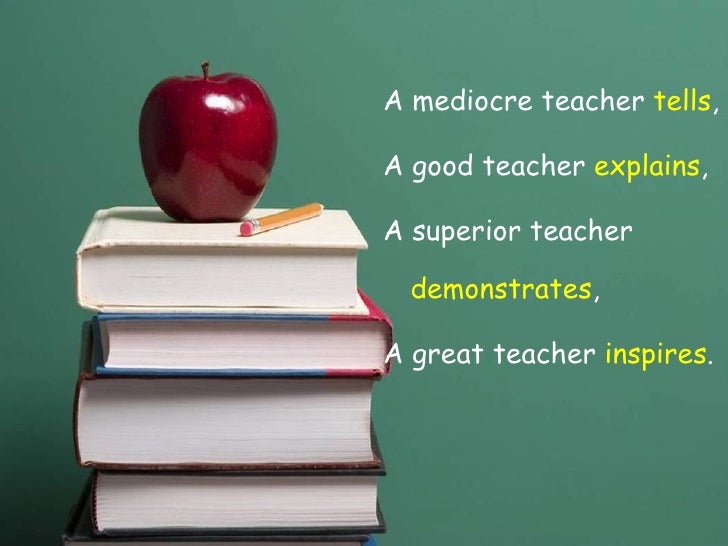
     The word teacher come from the word teach. If you look up the definition of a teacher it is said that it's someone who teaches, especially in a school. However that is not it. A real teacher is not in a classroom only to simply teach Science, Math, History, or English. A good teacher should have the mentality of doing much more than just that for her/his students.
<ul><li>A mediocre teacher  tells , </li></ul><ul><li>A good teacher  explains , </li></ul><ul><li>A superior teacher  dem...
https://www.slideshare.net/Yagovkina732/what-makes-a-good-teacher-1276854
     Through out our post you are able to find out what real good teachers are supposed to be doing for their kids. In one of the previous post you will find your self seeing the list below where it's a reminder of things to do, to be considered a good teacher:
  • Enjoy teaching- Teaching has a number of discouraging factors that stand your way and make it a challenge. However, for someone who has the drive, passion, and enthusiasm for their job, can get past these small hurdles.
  • Be accountable- This is important not only for your own professional career but it will benefit your students as well, which should be your priority.
  • Adapt-  You may find yourself having to adapt a lesson plan. The most effective teachers develop the ability to make changes to lessons or activities on the fly because of an unforeseen situation or problem. 
  • Challenge and Inspire- You have the unique opportunity to give your students the motivation to become lifelong learners. A truly great teacher can make a lasting impact that follows a student throughout their life.
  • Be able to relate (be human)- Students will also go through issues outside of school that requires adjustments within the classroom, so compassion is important.
  • Be determine: Teachers also tend to be fearless, resilient, and have a certain amount of grit. Obstacles will come up throughout the school year and it is important to stand up to criticism or scrutiny for things you believe are right.
     However not everyone follows those things. They think as the definition said you must just teach them whichever subject it was that you decided to teach and that is it. That is why we have many bad teachers;
Yet that does not mean all teachers are that way, even tough it may feel or seem like it at times, there is plenty more resources that tell us other wise, and that show us how to stay on track and the be the great teachers we would want our kids to have, we know we can and should be for other's kids.

work cited:
https://www.merriam-webster.com/dictionary/teacher
https://www.thoughtco.com/the-most-essential-qualities-of-a-good-teacher-3194340

Depression Among College Students

By: LaRyia Ferrie
Photo Credit: thinkably.com

Depression rates are the highest among college students. Lack of sleep or sleeping too much, lack of appetite, and dramatic changes in behavior, are all common signs to look for in someone with depression. Depression can be caused by academic stress, financial problems, being overwhelmed, and being lonely - many of these reasons are enough to make a college student depressed.

A wide variety of students are not prepared for what college will be like. They enter school thinking it's partying and drinking all the time, but the reality is - college is difficult. It takes a long time for some people to adapt to being in college, especially when living on campus. It is a dramatic change in ones life, making many students depressed. Depressed students have a greater risk of developing substance abuse problems. College students with depression are more likely to drink excessively and smoke marijuana. Students dealing with depression will also start to lack in their studies and skip class more and more.

In the United States, suicide is the second leading cause of death among people aged 15-34 years. Among young adults, 8.3 percent of 18-25 year olds have had serious thoughts of suicide. Depression is one of the biggest risk factors for suicidal youth. Other risk factors include:

  • Substance abuse
  • family history of mental illness
  • stressful life events
  • self-harm behavior such as cutting
  • prior suicide attempts


College students are more often reluctant to seek help for their depression. It is important for students to know that they are not alone and everyone around them is also adapting to this new life of college. Most colleges or universities have free counseling, so it is an advantage for these students to take this opportunity and get help. The best treatments for college students with depression are antidepressants and cognitive behavioral therapy.

If you or someone you know is struggling with depression, help them (or yourself) to get the treatment needed. Everyone deserves happiness.

Works Cited: https://www.healthline.com/health/depression/college-students#2

Monday, October 30, 2017

Prompt #3


I decided to sit down and interview my sister who is starting her career in the special education field at her alma mater.

Q: What do you do for a career?
A: I am an Intervention Specialist at ___ High School and I have a Multiple Disabilities classroom.

Q: Why did you choose to teach in this field?
A: I chose to teach in this field because I have a strong passion for working with children with disabilities. these children have endless amounts of potential and need an educator that is going to help them become independent contributing members of society.


Q: What goes into your lesson plans? How do you prepare it?

A: For my lesson plans, I usually prepare a few days to a week in advance. I do not like to plan too far in advance because since I have kids with such high needs, often the work does not get done. It takes a decent amount of planning to go into my lessons because I must differentiate everything I do in class. I have some students who can read and some who cannot, I have some that are verbal and some that are nonverbal, so all my lessons must be tailored to align with each student and their needs.


Q: How much time do you have to put in outside of the school day?

A: I typically put in an hour or two each day after school. That goes anywhere from completing IEPs, progress reports, and other paperwork, to just simply preparing stuff for class. Some days it is more and some days it is less, it just depends on what all needs to be done at the time.


Q: What does a daily schedule look like for you?

A: Every morning we do calendar where we go over the day, month, weather, etc. After that some of my students will go down to the cafeteria and do some work. When they come back that is when our instruction time starts. Typically, we spend about two hours in the morning working on academics or IEP work. I have one student that leaves to go to a food and fitness class, and I have another student that will leave on Tuesdays and Thursdays and will go do some work in the community. Once our instruction time is done, we get the kids ready for lunch, and after lunch they work on their vocational work which is the Frisch's kids coloring packets. They put those together every day. Once that is done we go to gym, and then once gym is done we head back to the classroom and get the kids ready to go home. 


Q: Are there any misconceptions or stereotypes in your field that you have experienced?

A: I think with the type of students in my classroom, people might think that my students are not very capable of attaining anything and some people may not take the time to see the potential that my students really have.


Q: How do you work around those?

A: I try to include my students into the gen ed. population as much as possible, so the staff and students can really get to know my kids and see that they are more than just what these people see on the surface.


Q: What advice would you give to new college students or graduating high school students that want to become teachers?

A: As soon as you enter college wanting to become a teacher, all eyes will be on you, and you are now in the works of becoming a professional. Remember that you never know who people know, and what you post on social media can and will be used against you if it is not appropriate. I have deleted some social media, and I personally know people that jeopardized their careers because they posted inappropriate things online. Be aware of what you are saying, always! Remember what made you want to become a teacher in the first place and run with that, because it is going to be hard. It is still hard for me now, but seeing those kids everyday makes my job worthwhile. 

- Joe

Sunday, October 29, 2017

College Admissions Really Stresses out High School Students

By: LaRyia Ferrie
I remember my senior year being totally scared while filling out multiple college applications. After doing so many, my thoughts were really racing. "How will I choose?" "Will I even get accepted?" "What if I don't get into the school I want?" These are very common scenarios for high school students when applying to colleges.  In fact so many students are stressed during this time of their lives that researches from New York City conducted a study to explore the stress levels of high school students in competitive settings. The study was published in the journal Frontiers in Psychology.

The study's senior researcher, Noelle Leonard, stated that "We are concerned that students in these selective, high schools can get burned out even before they reach college." The research team launched their study in four different stages to assess student coping skills, academic engagement, family engagement, expectations, and mental health symptoms, and alcohol and drug use to discover what the leading cause of chronic stress was for today's youth. The study focused on schools in high competitive private schools.

First, the researchers interviewed 19 private school teachers, counselors, and administrators about how they have seen students stress and cope. They then analyzed 128 anonymous surveys from the students at the school that were in there junior year.

The results showed that 48% of students spent 3-4 hours a night completing homework. Girls were 40% more likely to finish the 3-4 hours of homework than boys were, resulting in higher GPA's. Besides their academic success, 49% of all students reported that they felt a great deal of stress on a daily basis, and 31% said they felt "somewhat" stressed. Grades, homework, and college prep were the three main factors of the student's stress levels. 26% of participants reported symptoms of depression at high levels.

The researches then reached out to 18 of the 128 students to get more information on their responses. Lastly, they sent their findings to eight private school experts ranging from psychologists, social workers, one teacher, and one private school graduate. The teacher responded saying,  "I think that parental pressure on schools and students is real, parents are coming in and thinking, "I'm spending a lot of money and I need to get something, a very tangible something." A great education is not a tangible something; a diploma from Harvard, Princeton, or Yale... that's tangible."

According to the American Psychological Association, college and university counseling services an increase in the number of cries for help. It is true that a large percentage of high school students are attending colleges, it does not make up for the sharp rise in recent years. According to a 2013 national survey, college counseling services across the country, 32% have waiting lists because there are so many students seeking help that they can not fit them all in. Overall, students are stressed while filling out applications and still stressed far into the start of their college.

Photo Credit: static.wixstatic.com


Works Cited: http://www.medicaldaily.com/high-school-students-are-stressed-out-about-college-admissions-reality-burning-out-347476

Saturday, October 28, 2017

Prompt #9 - Recognizing Significance


Psychology is at times misrepresented or misinterpreted and can confuse people of what the importance of the field is. Psychology, by definition, is "the scientific study of the human mind and its functions, especially those affecting behavior in a given context" (Google). So knowing that we can find what significance has come out of the field and into the existing world.

A study on prescription painkillers and chronic pain surfaced the web last year in May. The research team gave morphine to rats for five days, and after those days were up resulted in the evidence. The team found that "opioid use increases chronic pain in rats," suggesting that if the same result is true for humans, opioids are rigorously addictive and worsen the condition rather than helping it. "We found that the treatment was contributing to the problem," said Research Professor Peter Grace.

Photo: Henry Kotula
This study and research does not just come naturally, this was a find from a specific team tasked with finding the psychological and psychical effects of opioid use on rats. Now that can link chronic pain with opioid use in rats, we can begin the study looking for the same results in humans and other animals. If there is such of a connection, we would have evidence, understanding of it, and how to counter the effects all because of a little curiosity of what opioids do to rats.

The work done in psychology benefits several aspects of life including health, relationships, happiness, and more. The insight that previous research has given us helps us understand how the body and mind works and how it reacts to things. It also helps with psychological illnesses, giving doctors a chance to develop medicine and cures for patients. Psychology offers more to the world than what's understood of it. When we take time to understand our own mind and bodies, then we can learn how to treat and handle it better.

by Lucas W.

Works Cited:

Carter, David. "Why is psychology important? - Quora." 23 September 2015. https://www.quora.com/Why-is-psychology-important-1

DiSalvo, David. "Prescription Painkillers May Worsen And Lengthen Chronic Pain." 30 May 2016. https://www.forbes.com/sites/daviddisalvo/2016/05/30/prescription-pain-killers-may-worsen-and-lengthen-chronic-pain/#65bf5537eeb4

Becoming a Leader

Photo: Kit8

Leadership is learned and becomes automatic throughout time. Some people are naturally born with leadership skills, and some watch and learn from others. Becoming an effective leader is more about what you do rather than what you know. Making the right decisions for not only you but those who look up to you.

The first starts with keeping promises. Leaders are tasked with doing so much that things may become forgotten or unapparent, that's why you should never make a promise without the intention of following through. "Nothing kills credibility quicker than unfulfilled expectations," says Mark Sanborn from Entrepreneur. Sometimes keeping promises is harder than not keeping them, so know when to set the bar and say "no", and when to take on the challenge.

Communication is one of the most important traits and skills of great leaders. Many times leaders seem intimidating to others with their title and influence, but leaders who encourage others to speak their opinion are the ones most well connected to the people. To involve everyone is to gain trust from everyone and even see their perspective of you. Whether it be good or bad it will help identify where success is needed, and where it is best.

Leaders are mostly in charge of making the first decisions for people, pathing the way for those behind them. So to be a great leader, you need to make great decisions. Focus on constantly "making things happen" to always sustain progress. No matter how slow or fast, short or far when progress was done, progress is made. Also, take time to learn others view of the future and try to keep a balanced perspective for all. Keeping a clear-cut view of the future helps with making decisions in the present.

Photo: Cliff Knecht Artist Representative

A leader isn't only about helping himself, a leader is about making sure that those around them are steady before they are. To lead by example promotes future leaders by practicing what you preach. Only when people observe great leaders will they know why they need to become one for others.


by Lucas W.

Works Cited:

Llopis, Glenn. "The Most Successful Leaders Do 15 Things Automatically, Every Day." 18 February 2013. https://www.forbes.com/sites/glennllopis/2013/02/18/the-most-successful-leaders-do-15-things-automatically-every-day/#57b4dbd469d7

Sanborn, Mark. "5 Ways to Train Yourself to Be a Great Leader." 3 April 2013. https://www.entrepreneur.com/article/226265

Friday, October 27, 2017

Be a Good Teacher


https://www.pinterest.com/alwaysTracieL/the-friends-and-family-plan/
   As a teacher it is extremely important that you don't just see your classroom, filled with students. These kids should stop being just kids, just any students to you. You are an important and influential adult in their life. You are in their life for 5 days a week, for about 8 hours every week. I think it's important that you see them as your kids. When you start to view them as your kids, there is a lot more to it. This will make you an amazing teacher. You will care for them, which will mean you will be filling in all the other hats that you are supposed to as a 'good teacher'. This is important because you should be aiming to become a good teacher. If not, then why strive to become one? Do it right, or don't do it at all. What I mean by your kids, is I mean is view them with importance. Make sure there is safe zones. Be there for them as more than just a teacher. Make it feel like family at school.
When you do this keep in mind that you are doing this, because you are one of the most critical factors of your students achievement. Students with effective teachers will score 50 points higher in math skills than those with ineffective teachers. 

  • Enjoy teaching- Teaching has a number of discouraging factors that stand your way and make it a challenge. However, for someone who has the drive, passion, and enthusiasm for their job, can get past these small hurdles.
  • Be accountable- This is important not only for your own professional career but it will benefit your students as well, which should be your priority.
  • Adapt-  You may find yourself having to adapt a lesson plan. The most effective teachers develop the ability to make changes to lessons or activities on the fly because of an unforeseen situation or problem. 
  • Challenge and Inspire- You have the unique opportunity to give your students the motivation to become lifelong learners. A truly great teacher can make a lasting impact that follows a student throughout their life.
  • Be able to relate (be human)- Students will also go through issues outside of school that requires adjustments within the classroom, so compassion is important.
  • Be determine: Teachers also tend to be fearless, resilient, and have a certain amount of grit. Obstacles will come up throughout the school year and it is important to stand up to criticism or scrutiny for things you believe are right.
work cited:

Monday, October 23, 2017

Kids Dealing with Parents Divorce

By: Liz

   Marriage has changed a lot in the past couple years. Before I feel was more emphasized and looked at as a promise made upon God. I feel as if it was a bigger fear to divorce, because they viewed marriage as a commitment for life as it was set to be viewed as. There is many more divorcement / single parenting going on now-a-days. This has an affect on kids and it's important to try and help, because as the teacher you spend like 8 hours with them, they are your kids too and you should always be there for them.
   However for some reason teachers always asked me to leave my problems outside of the front doors when I walked in class. There was times where I wished it was that simple to just forget what was bothering me and have a peaceful regular day. However I do not personally agree with that, because sometimes we as human should understand that especially kids can't just leave that behind them. Sometimes they need our support, our help.
   I think it's important that we know information about this, because at times we will have students in our class room who can't focus, who are sad, kids who need an adult in their life showing them some love and support, because they have family problems. 50% of the divorce cases have an involvement with children. I read the article "Helping Students Going Through Divorces" which is where I learned the new information on this.
   It's important to keep in mind that it takes 1-2 years for a kid to get used to a new family system. To try and help them, begin the teacher you can make a safe space, where they can talk to you or even keep a journal that only you have access too. Also keep in mind that there is a set of 5 things you can do to help the student going through rough family problems, this includes:

  • Discussion opportunities - hear them out 
  • Words of encouragement - be caring and accepting
  • Communicate with parents - keep both parents in the loop
  • Maintain structure and routine - make sure they follow a schedule 
  • keep a boundary - set limits
https://www.rd.com/advice/parenting/slideshow-13-things-your-childs-teacher-wont-tell-you/


Work cited:
http://www.teach-nology.com/teachers/parents/divorce/

Sunday, October 22, 2017

The Truth About Teaching Salaries

An average of forty-five percent of staffed, salaried teachers leave the profession after five years. Twenty percent, in urban areas, leave after their first year. Sixty-two percent of surveyed teachers have to work a second job to make a livable income. The yearly turnaround will cost the United States over $7 billion.

Why is all of this happening?

Credit to: Forbes

For the most part, we can point at the salary. The average first-year salary for a public school teacher (private schools obviously pay higher) is $39,000 and can eventually increase to $65,000-$70,000 after your twenty-fifth year, which is when some teachers end their career. On average, they make fourteen percent less than professionals in other fields that hold salaried positions. McKinsey polled 900 college students and found that 68 percent would "consider teaching if salaries started at $65,000 and rose to a minimum of $150,000." That survey tells you enough about to know that a backdoor problem is visible.

In comparison to South Korea, the government hires and trains staffed teachers and pays them 250% more in terms of currency balance. The yearly teacher turnover there is only just more than one percent.

In the next ten years, about half of the total teaching population (estimated 1.5 million) will retire. Who's going to replace them? Will college students shift their majors in a supply-and-demand stance? Will the increase in need of qualified teachers cause a needed salary increase?

- Joe

Statistics contributed to the New York Times

School Psychologist

By: LaRyia Ferrie
Photo Credit: nasponline.org


What is a school psychologist? They are qualified members of a school who help in supporting students ability to learn, and teachers ability to teach. They apply their knowledge in health, mental ability, and behavior in order to help children and students succeed academically, socially, emotionally, and behaviorally. School psychologists partner with many people such as families, students, teachers, school administrators, and other professionals to create a healthy and safe learning environment throughout the school. They also promote connections between the home, school, and community.

School psychologists need training. In order to be a school psychologist, one must receive specialized   advanced graduate preparation involving both psychology and education. This preparation includes coursework and practical experiences. They typically complete a specialist - level degree program or a doctoral degree. Both programs include a year long 1200 hour supervised internship. Graduate preparation develops knowledge in many aspects such as:

  • Mental Health Interventions 
  • Assessment
  • Progress Monitoring 
  • Data Collection and Analysis
  • Special Education Services 
  • Prevention and Intervention Services
  • School-wide Practices 
  • Academic/Learning Interventions
  • Research and Program Evaluation
  • Family-school-community collaboration 
  • Behavioral Interventions
It is required that school psychologist be credentialed by the state in which they are working in. They must also be nationally certified by the National School Psychology Board (NSPCB) The National Association of School Psychologists (NASP) sets standards for graduate preparation, credentialing, professional practice and ethics. 

School psychologist can work in a variety of places. Some of these locations include: private schools, preschools, universities, school mental health centers, juvenile justice programs, and independent private practices. 

School psychologists provide direct support and interventions to students, families, teachers, and other school-employed mental health professionals such as counselors. They work to improve strategies, give support, improve school practices and polices, and provide needed services. School psychologists successfully improve academic achievement, promote positive behavior and mental health, support diversity, create safe environments, and strengthen family-student relationships. Every school needs one as they help students and youth thrive in school. 
Photo credit: pdresources.org
I learned this information through researching among many days because I one day hope to become a school psychologist. I did online researching and read articles about the career, as well as watch some YouTube videos on people's experience of being a school psychologists. I learned that having a school psychologist can really benefit a school as they promote healthy behaviors. Anyone in need of help can talk to their school psychologist about almost anything. They are there to help not only the students, but teachers as well. Everyone included in a school setting may need advice or guidance at some point and that is what the school psychologist is there for.

Works Cited: https://www.nasponline.org/about-school-psychology/who-are-school-psychologists

The Effects of Bullying

There doesn't have to be physical contact between a threat and their target to cause harm. People who are bullied may carry emotion damage without ever being physically harmed, and that's why it's important to become aware of bullying. "It is estimated that about 20% of all kids are bullied in school at any time," according to eSchoolToday. The numbers will only go down once we act on the issue, and know what causes it can spawn.

Photo: Bryan on Scouting

Those who are bullied in school soon lose their interest in education, challenging their future academics and success. In a survey from Cornell, "they found that dropout rates were 29% higher than average in schools with high levels of teasing and bullying." That's too high of a percentage to be comfortable with, showing that schools should put more effort in keeping bullying out, and keeping graduation in. In other cases, the victim may seclude themselves from other people as a result of feeling depressed or anxious. That would only put the victim on medications or therapy rather than fixing the root of the problem at hand, bullying.

So now that we know what could happen, how do we stop it from happening? We can take many approaches to stop bullying, one being to take immediate action. If you see someone being bullied, then do not wait, go and help them. Intervening can stop the escalation and make the bully think twice about acting out. Setting a good example is another way, influencing everyone around you. Make sure that you are not perpetrating bullying behavior, and spread the word that bullying has to stop. Once everyone becomes aware that there is a problem, it is easier to address it.

Photo: Ryan Semenluk

Bullying is just another form of abuse, and it is clear that it causes short and long term consequences. Lingering feelings of anger, depression, self-esteem issues, and even worse self-harming thoughts are a few results of it. Lying as the big elephant in the room, we all need to recognize it as reality: bullying is real, and victims are being wrongfully hurt. In order to keep schools safe for everyone and give a fair chance of success for all, we need to look out for another, especially if we see bullying happening in our own community.

by Lucas W.


Works Cited:

Daniels, Ellen. "U.VA. Study Links Prevalence of Bullying, Teasing to High Dropout Rates." 31 October 2012. https://news.virginia.edu/content/uva-study-links-prevalence-bullying-teasing-high-dropout-rates

Saint Louis, Catherine. "Effects of Bullying Last Into Adulthood, Study Finds." 20 February 2013. https://well.blogs.nytimes.com/2013/02/20/effects-of-bullying-last-into-adulthood-study-finds/

Sunday, October 15, 2017

Prompt #1

By: LaRyia Ferrie
Photo Credit: Brainblogger.com

Many people who are not experienced in the field of psychology have various opinions, comments, and ideas on what they think Psychology is all about. Half of these assumptions are in fact - false. Psychology is a complex field with hundreds of ideas involved in it. It is not easy to learn, which some people may think. Here are some common misconceptions people have about the field of Psychology as a whole.

  •  Psychology is easy. 
  •  Psychologist just get paid to listen to people talk.
  •  Psychology is not a real science.
  •  Psychologists can read minds.
  •  Psychology is just common sense.
Even though I  know all of  these misconceptions are entirely not true, at one point I have considered some of them. After taking multiple psych courses in high school and now college, I can truthfully admit I was wrong about all of the misconceptions I once had. My Intro to Psych 101 book, "Psychological Science" can prove some of these misconceptions as false statements. 

1. "Psychology is easy." 
Many people believe psychology will be interesting and a breeze so they should take psychology courses to just get the A. This is not true. Psychology is more than just learning about personality and brain development, etc -  there are many statistics and research based papers involved. It is not all about remembering theories and terms, it is also conducting your own research based paper, doing math, writing statistics and much more. You must use critical thinking in the field of psychology. The book states that, "Being a critical thinker involves looking for holes in evidence, using logic and reasoning to see whether the information makes sense, and considering the alternative explanations." None of which is easy, but it can be done!

2. "Psychologist just get paid to listen to people talk."
People who know nothing about psychology think that psychologists get paid to sit in a room all day and listen to patients tell their life stories. This is another false belief. Although psychologist can be paid to listen to people, it can be more than that. The book writes that psychological knowledge is used in many professions, "Psychological knowledge include research assistants, attorney's assistant, police officer, social worker, personnel director, hospital counselor, and persuading jurors." Psychology does not have to be about just sitting with a patient all day long, it branches out to many different areas of ones interests. The textbook also states, "most psychological science has little to do with therapeutic cliches such as couches and dreams. Instead, the goals of psychology are to understand mental activity, social interactions, and how people acquire behavior."

3. "Psychology is not a real science"
Many believe that psychology is not a science. Psychology is the study of the mind, brain, and behavior.  Some characteristics of science include: hypotheses testing, empirical methods, researchers controlling and manipulating variables, results being replicated, and results leading to finding new research. All of these concepts are widely used in the study of psychology on human and animal behavior. Researchers use the scientific method to conduct their research, as well as manipulating or controlling variables. Just because psychology is a relatively new science, does not mean it is not a real science.

4. "Psychologist's can read minds."
Often, people believe that because someone is a psychologist, that they can read another persons mind, or categorize them. This is not true. Psychologists do notice certain characteristics in people related to some sort of disorder or disease, but they are not telepathic. Psychologist comprehend human behavior, but they do not form any super powers, whatsoever.

5. "Psychology is Just Common Sense."
It also believed that psychology is just seen as common sense. The textbook explains that, "The results of psychological research are often surprising and often run counter to common beliefs. " With common sense, just because you think something should be true, does not always mean that it is. In the example of Stanley Milgram's Electric Shock experiment, random participants were told to deliver electric shocks to another random individual if they answered a question wrong. You would think that the person delivering the fatal shocks to a stranger would not continue with the experiment, even though an authoritative person was telling them not to, right? In this case, you're wrong. Therefor, psychology is not always common sense, many things may be shocking.

The Intro to Psychology course textbook was indeed very useful at proving most of these misconceptions. In the first chapter, it explains what psychology is, how it can be used, why study it, and many other topics. It tells the truths about psychology, and that it's not just sitting in a quiet room listening to patients all day - it's finding research, studying behavior, and thinking critically. The textbook gives a good understanding on why psychology is important and why many people considering studying it should stick with it. I knew that psychology would not be easy and I knew that psychology was more than listening to somebody, but the book really helps to get an understanding of the full extent of studying this particular field. All together, the textbook "Psychological Science" gives clear information to anyone interested in studying psychology. 

Works Cited:
Gazzaniga, Michael, et al.  Psychological Science. 4th ed., W.W. Norton & Company. 2011. 

https://www.verywell.com/myths-about-psychology-2795594


United States Department of Education

After Betsy DeVos was sworn in as the seventeenth Secretary of Education on February 7, 2017, many people have asked "What does that person do?"

Credit to: CBC News
The Secretary of Education cannot determine budgets or tuition costs for primary or secondary schools. It is considered one of the weakest cabinet positions in the capital. Some of Secretary DeVos' main assignments are to "advise and enact policy, collect data, administer funding, and handle discrimination complaints regarding education. Sexual assault claims on college campuses are also tied in to the SOE, as they have to uphold government policies. She is also responsible for maintaining the Individuals with Disabilities Education Act, which states that people that have mental disabilities should not have to pay for school.

Some also might ask if you need to be a teacher to hold this position, and the answer is "No". Just like with President Donald J. Trump, you don't need to be a person in that career field to hold a spot in the White House. DeVos actually had to have Vice President Mike Pence break the tie to elect her in, becoming the first Secretary of Education to do so.

Published by: Joe

Information provided by the Master of Education Degree Guide

The Struggle of Being an ESL Teacher

   By: Liz

   English might be the primary language as many people would argue that is spoken in the united states, however there is way to many people in this world. A few people will even say things like "we are in America. You need to learn English." However in my defense there is many countries, and many different wide-spread languages. English is and will never be the only language people speak. There is traveling, migration, and even immigration. Therefore as I said, even if English was the first language or not it will never be the only language that is spoken in the United States.
   As I said there is cruel people who will dis, or think of someone as less because they don't speak any or fluent (well) English. However it's sad to think people think English should be the only language spoken here in English. People should spread their knowledge and learn different languages. It should be an honor to know more than one language not a bad thing.
http://www.amerika.org/wp-content/uploads/diversity_map.png
   To have English be your second language does not stop you from being an ESL teacher, however it will come with several challenges. I read the article 8 challenges for today’s ESL teachers (and how to handle them) and what I previously mentioned came up a lot. First off is the English immersion. I hate the fact that what I said previously is very true, and even as being an ESL teacher, they would go on and ask you to speak nothing but English to your students. This really will happens at times so maybe that is not the correct job for you or maybe you will have to adapt and follow the rules. Furthermore this might be very hard and upsetting, but at times as I said you will be left, looked at, and treated like nothing but an outsider. It's difficult, I know to be minority, to look different. but don't let them get in your head. You got your degree, your there now, and you know more than just one language. You are a step ahead, and have achieved a lot. Be proud of yourself and don't allow them to get in your head. Be the bigger person, and ignore the fact that they are just ignorant people.

work cited:
https://matadornetwork.com/abroad/8-challenges-for-todays-esl-teachers-and-how-to-handle-them/

Synthesis Post

By: Laryia, Liz, Joe, and Lucas Photo Credit: GoodTherapy.org The fields of education and psychology are two very important subject...